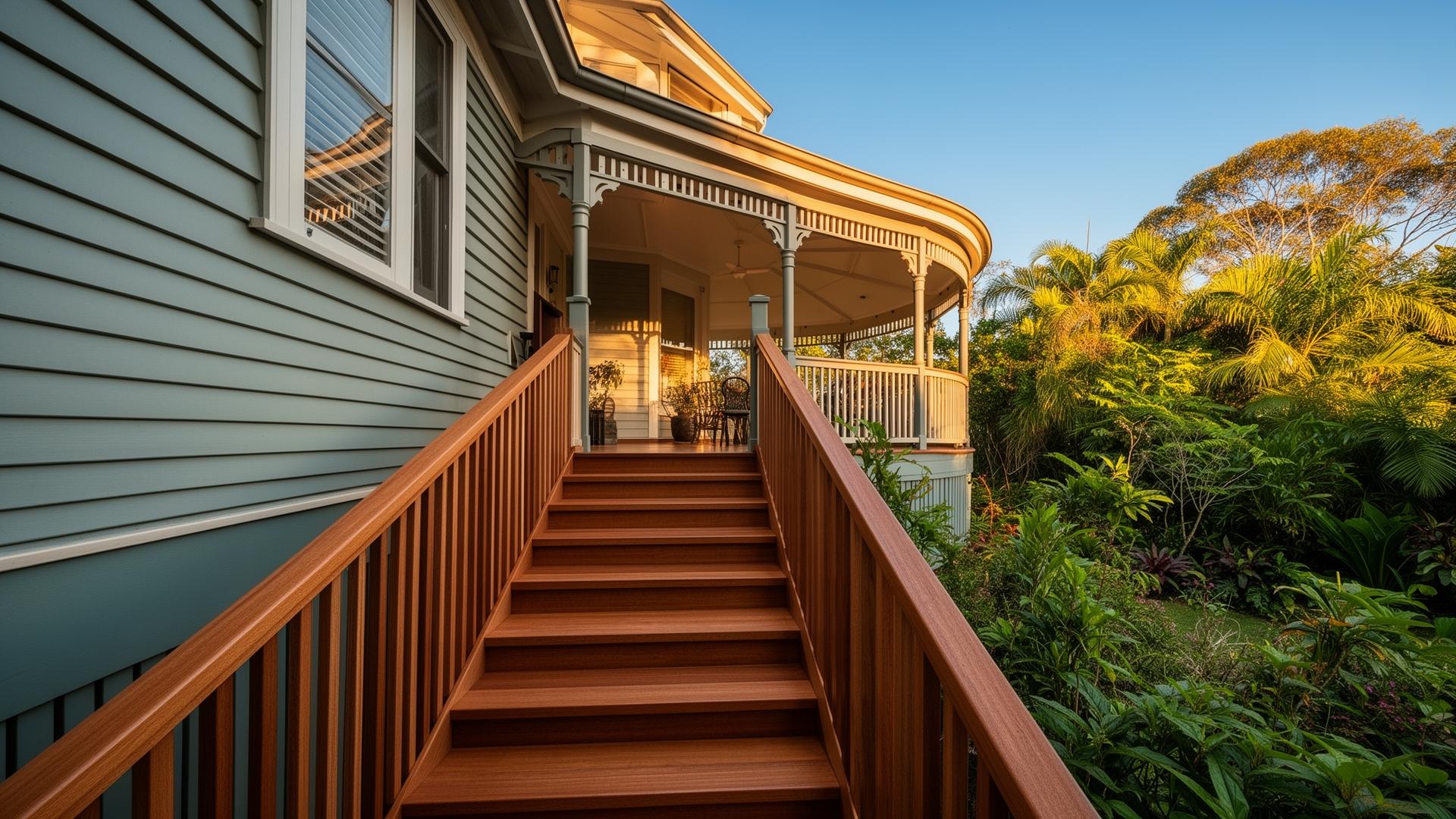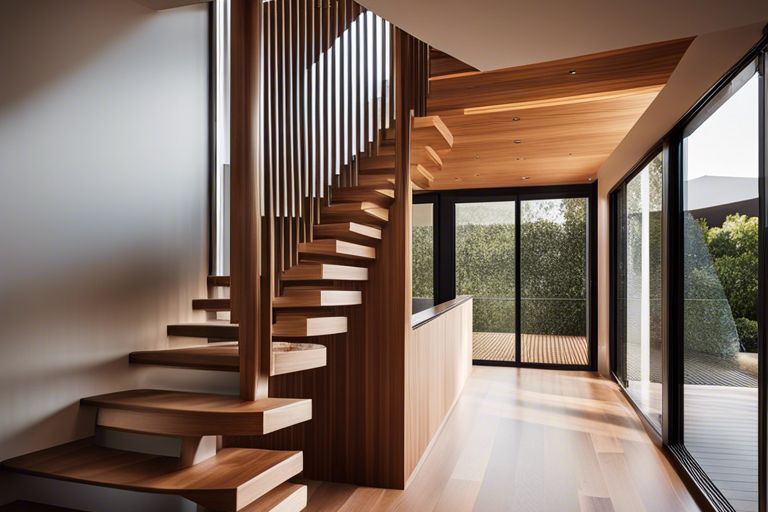
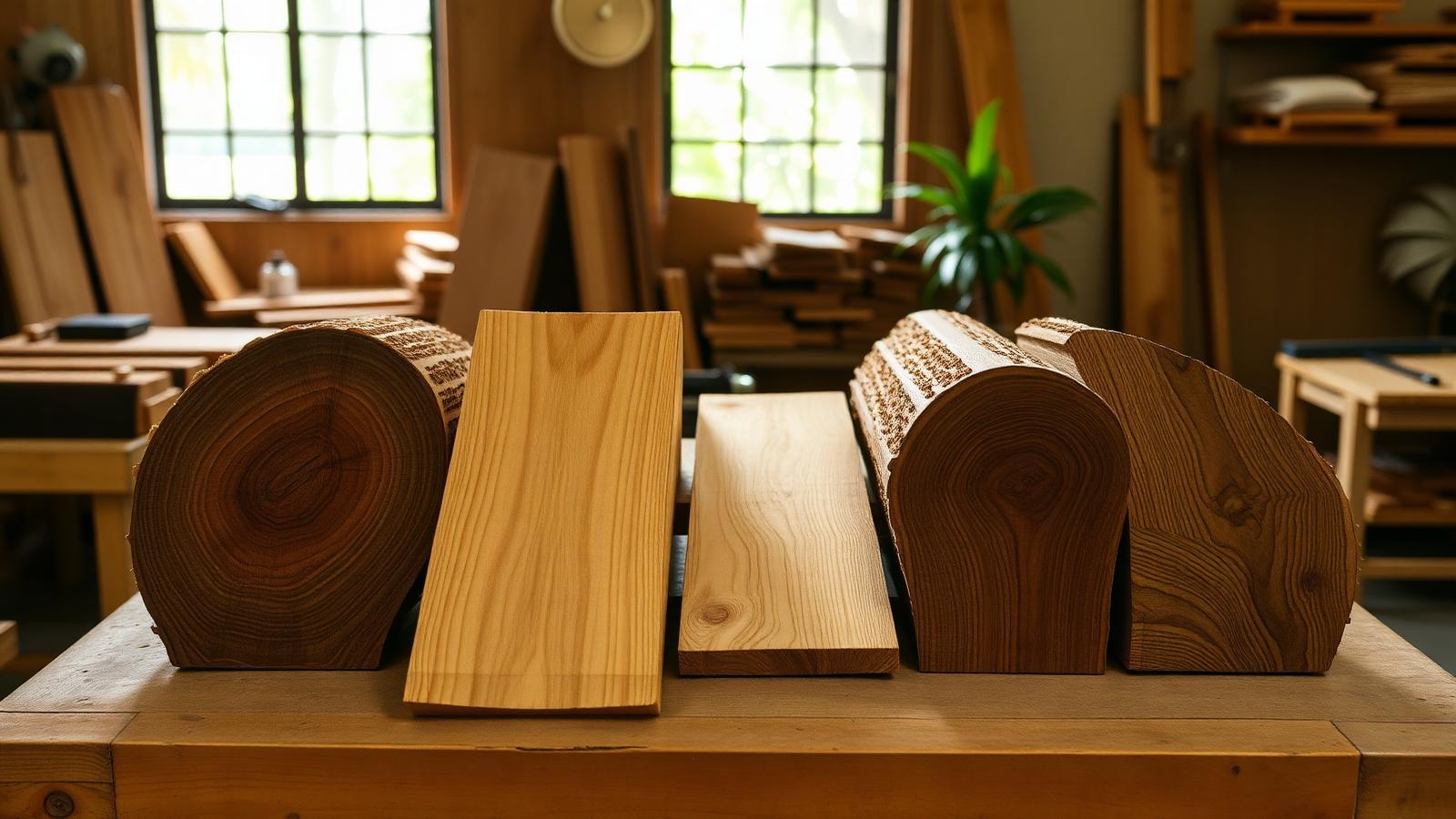
Spotted Gum and Ironbark are the best all-round timbers for outdoor stairs in Queensland. Both are Class 1 or Class 2 durable Australian hardwoods that handle South-East Queensland's subtropical climate, high UV load and termite pressure with predictable, long service life.
But the right choice for your home depends on exposure, budget and design. This guide compares the top species under AS 5604 durability ratings and explains where treated pine, Blackbutt, Tallowwood and Merbau fit in.
What Matters in Queensland Weather
Outdoor stairs in Brisbane, Moreton Bay and the Sunshine Coast face four climate stresses: intense UV, summer storms, high humidity and termite pressure. The timber you choose must resist all four.
The Australian Standard AS 5604 classifies timbers into four durability classes for above-ground service. For Queensland external stairs, only Class 1 and Class 2 hardwoods make practical sense.
Key selection criteria
- AS 5604 durability class — Class 1 (25+ years) or Class 2 (15-25 years) above ground.
- Hardness — Janka rating above 9 kN resists denting from heavy boots and furniture.
- Movement — Low tangential shrinkage reduces cupping and checking through wet/dry cycles.
- Natural termite resistance — important even with a chemical barrier.
- UV stability — affects how often you need to recoat.
Top 4 Hardwood Species for Outdoor Stairs
These four species cover 95% of quality external stair builds in South-East Queensland.
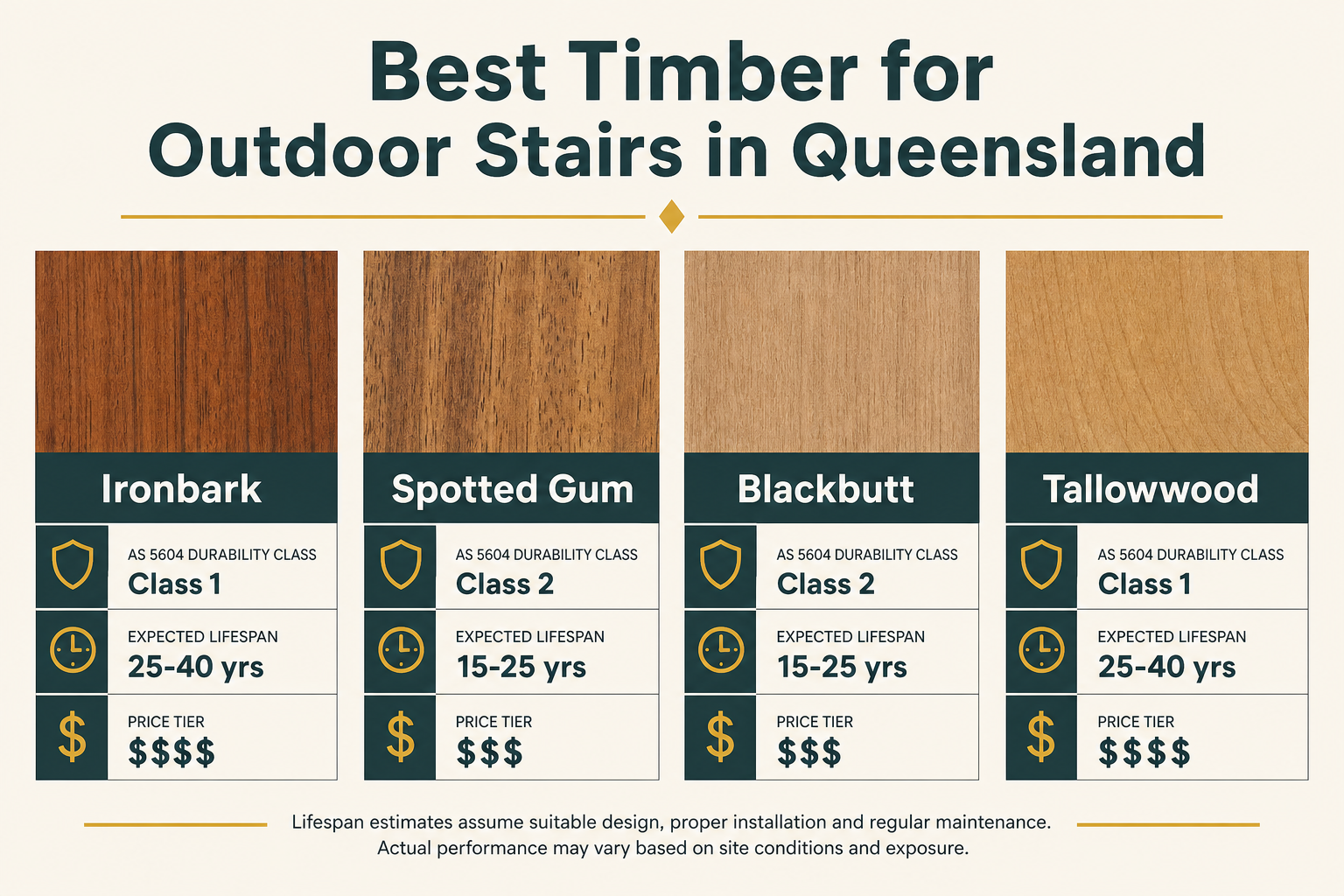
1. Spotted Gum (Corymbia maculata)
Spotted Gum is the workhorse of Brisbane external stairs. It's Class 2 above ground, has a beautiful flecked grain, and is straightforward to machine and finish. Janka hardness around 11 kN.
Expect 15-25 years in service with a recoat cycle every 2-3 years. It's the species we recommend for most Queenslander stair replacements unless the location is fully exposed to weather.
2. Ironbark (Eucalyptus paniculata / E. crebra)
Ironbark is the heavyweight — Class 1 above ground, Janka hardness around 14 kN, and exceptional natural termite resistance. It will last 25-40 years on a well-detailed stair.
The trade-off is weight, cost (15-25% above Spotted Gum) and difficulty machining. Best reserved for fully exposed stairs or premium specifications.
3. Blackbutt (Eucalyptus pilularis)
Blackbutt is Class 2, paler in colour than Spotted Gum, and slightly less hard (Janka ~9.1 kN). It's a great choice when the design calls for a lighter palette, and it has BAL-29 bushfire rating — relevant in semi-rural Sunshine Coast hinterland areas.
4. Tallowwood (Eucalyptus microcorys)
Tallowwood is Class 1 above ground with a naturally greasy surface that resists slip when wet — a real advantage on Queensland's wet-season stairs. Slightly limited supply means it usually sits at the premium end of pricing.
Treated Pine — An Honest Assessment
H3-treated radiata pine is legal and code-compliant for above-ground external stair components. It costs around 40-50% less than Spotted Gum.
But it's softer, marks easily, and the treads typically need replacement at 10-15 years in South-East Queensland's climate. For a deeper cost analysis, see our external timber stairs cost in Brisbane guide.
Use treated pine for rental properties, sheds and short-term builds. Use Australian hardwood for any stair you want to forget about for 20 years.
Merbau & Other Imported Timbers
Merbau (Kwila) is widely sold at hardware chains and is durable. The downsides for Queensland stairs are real:
- Tannin leaching stains pavers, render and brick for the first 6-12 months.
- Sustainability concerns — much Merbau comes from poorly managed forests.
- Sourcing uncertainty — replacement boards can be hard to colour-match years later.
Australian hardwoods like Spotted Gum cost similar and avoid all three problems.
Matching Species to Your Site
Use this quick lookup to narrow your shortlist:
- Covered Queenslander stair (typical Brisbane): Spotted Gum.
- Fully exposed stair, west or north face: Ironbark or Tallowwood.
- Coastal Sunshine Coast (within 1 km of beach): Ironbark with stainless fixings.
- BAL-29 bushfire zone: Blackbutt or Spotted Gum.
- Heritage character home: Spotted Gum or Tallowwood for visual authenticity.
Maintenance Schedule by Species
All external timber stairs need a regular recoat to hit their full lifespan. The interval depends on species and exposure.
- Spotted Gum / Blackbutt: recoat every 2-3 years with a UV-stable oil or two-pack polyurethane.
- Ironbark / Tallowwood: recoat every 3-4 years.
- Treated pine: recoat every 18-24 months and inspect treads annually.
For finishing detail and product recommendations, see our timber staircase finishes guide.
Get Expert Species Advice for Your Project
The right timber depends on your site, budget and design. Craftsman Stairs has been building external timber stairs across Brisbane, Moreton Bay and the Sunshine Coast since 1989 (QBCC Licence 69007, ABN 86 475 603 796).
For the full guide on materials, design and compliance, see our external timber stairs in Brisbane and Sunshine Coast pillar page, or call 0439 730 583 for a free, no-obligation quote.
Frequently Asked Questions
What is the best timber for outdoor stairs in Queensland?
Spotted Gum and Ironbark are the two best timbers for outdoor stairs in Queensland. Spotted Gum offers the best balance of price, workability and durability for most homes, while Ironbark is the premium choice for fully exposed stairs facing the harshest sun and rain.
How long does Spotted Gum last on outdoor stairs in South-East Queensland?
Spotted Gum is a Class 2 durable hardwood under AS 5604 and typically lasts 15-25 years above ground in South-East Queensland when designed for drainage and recoated every 2-3 years.
Is Merbau a good choice for outdoor stairs?
Merbau is durable but imported and prone to tannin leaching that can stain pavers and rendered walls. For new external stairs in Brisbane and the Sunshine Coast, Australian hardwoods like Spotted Gum, Blackbutt and Ironbark are a better long-term choice.
Can treated pine be used for external stairs in QLD?
Yes, H3-treated pine is legal for external stair components above ground, but it has a shorter service life (10-15 years) and softer treads that mark easily. It's a budget option, not a long-term choice for Queensland coastal homes.
Which timber resists termites best for outdoor stairs?
Ironbark and Tallowwood have the highest natural termite resistance of common Australian hardwoods. All in-ground stair posts in Queensland must still have a termite barrier under the NCC, regardless of species.
Do I need a different timber for coastal Sunshine Coast homes?
Yes — within 1 km of the coast, salt-laden air accelerates timber weathering. Ironbark, Tallowwood and Spotted Gum perform best, paired with stainless steel fixings and a marine-grade UV finish.
Craftsman Stairs
QBCC licensed staircase builders with over 35 years of experience servicing North Brisbane, Moreton Bay and the Sunshine Coast. We design, manufacture and install custom staircases for residential and commercial projects.
Get a Free Quote